
Interview with Sandra Koch, United Nations Volunteers
“Climate action is one of the fastest-growing areas in volunteering”
The United Nations declared 2026 the International Year of Volunteers for Sustainable Development (IVY 2026). Coordination is being led by the United Nations Volunteers (UNV) in Bonn.
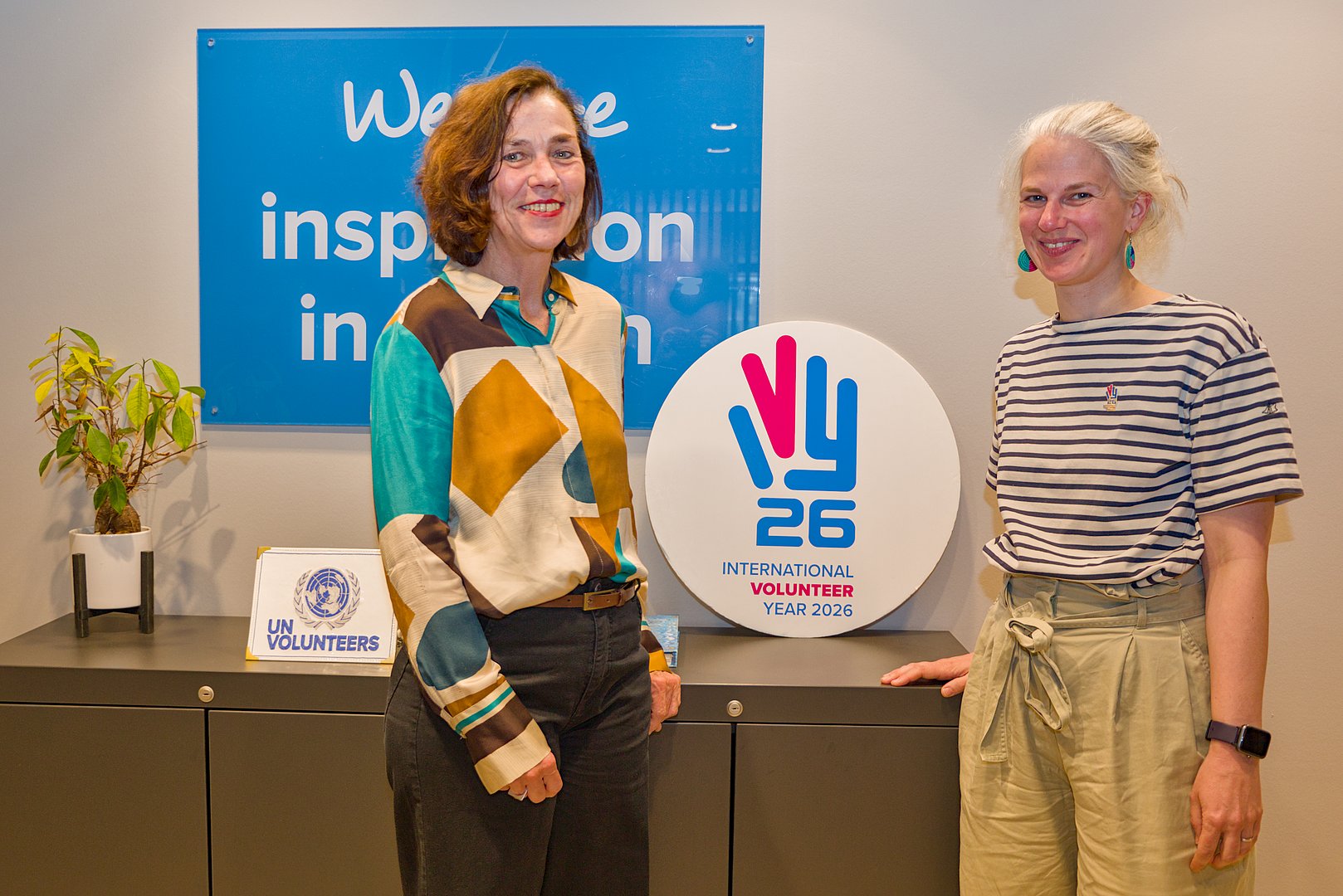
AGdD Executive Director Gabi Waibel spoke with Sandra Koch, who heads the IVY Secretariat at UNV, about the role of volunteering in international cooperation and the need to strengthen structures and secure funding.
International Volunteer Year 2026
What role does volunteering¹ for development play within the United Nations?
We are seeing growing recognition of its importance. Since UNV was founded in 1971, there have been regular UN resolutions supporting and strengthening volunteerism – since 2012, at least every three years. That has had a real impact. In addition, all countries report on how they implement the 2030 Agenda, and many identify volunteerism as a contributing factor. Thanks to this advocacy work within the United Nations system, volunteering has a very different standing globally today – a lot has changed over the past 55 years.
Volunteerism itself has evolved as well. Within the UNV program, for example, we now work with a growing number of national volunteers and see increased South-South exchange. Last year alone, we facilitated 17,169 volunteer assignments with United Nations organizations globally. Especially since the COVID pandemic, volunteering has also become more local and more digital.
Every four years, UNV publishes the State of the World’s Volunteerism Report. The 2026 report² provides a comprehensive, data-driven analysis of volunteering today.
How did the International Volunteer Year come about, what are its goals, and what does the Secretariat you lead actually do?
The IVY takes place 25 years after the first International Year of Volunteers in 2001. Back then, many countries established volunteer programs. A quarter of a century later, the time has come to shine a spotlight on volunteering once again. The overarching goal of the IVY is to demonstrate how volunteers around the world contribute to the 2030 Agenda. Another aim is to improve structures, legislation and infrastructure. Naturally, that also means greater investment in volunteers and the service they provide.
The IVY Secretariat itself is relatively small – there are four of us here in Bonn. Together with six regional coordinators, we support member states in implementing the IVY in their respective countries, primarily through extensive communications work. Part of our mandate is also to bring together the many different stakeholders involved. Alongside UN organizations, governments in member states are key partners, as are civil society organizations, the private sector, universities and researchers.
What does the International Volunteer Year mean for Germany? Who is responsible here?
Germany has long been – and still is – one of the pioneers of volunteering at the global level. It was one of six member states that actively promoted the resolution for this IVY. When we officially launched the IVY on 5 December 2025 with an event in New York, Germany was one of three hosts, alongside Kazakhstan and UNV. That reflects Germany’s global role.
At the national level, member states nominate a focal point for the IVY. In many cases this is a ministry, but it can also be a civil society organization mandated by the government. In Germany, that decision is still pending. Nevertheless, we are already seeing a great deal of activity here: the German Foundation for Civic Engagement and Volunteering (Deutsche Stiftung für Engagement und Ehrenamt) is participating through its funding program “action! Aktiv für eine globale Welt”, while German cities and other local actors are planning panel discussions and using the year as an opportunity to recognize volunteers for their contributions.
Volunteerism and civic engagement have long enjoyed positive public and political support in Germany. That now seems to be changing: the planned discontinuation of the Kulturweit program in 2027 (by the Federal Foreign Office), funding cuts to Weltwärts (by the Federal Ministry for Economic Cooperation and Development), and stagnant funding for the Civil Peace Service (CPS) are alarming signals. How can the IVY be used strategically to strengthen these international programs again?
The International Volunteer Year explicitly calls for strengthening structures, not dismantling them. It is the exact opposite of that trend. The IVY provides an important opportunity to advocate for programs that support sustainable development globally and to argue that they should be continued and expanded.
We should also not forget that the International Year was adopted at the global level. There is a clear commitment by the UN General Assembly to volunteerism. At the same time, it is an opportunity to underline once again that volunteering is not something that comes free of charge. It requires investment.
You yourself served as a development worker in the Civil Peace Service. How would you place development service, including the CPS, within the broader spectrum of volunteering worldwide?
I would place development service very close to the United Nations Volunteers model. It is a very similar approach, with a living allowance intended to cover basic costs. And it is also a qualified, long-term form of service. That is precisely why it is such an important element of international peacebuilding and why it strengthens institutions working on global challenges.
Convinced that development service is a highly effective instrument, we have developed a new program modeled on the CPS: the International Climate Service. Funding has yet to be secured. What role does climate change play in volunteering overall, and how important is this focus from your perspective?
One thing is very clear: climate action is one of the fastest-growing areas in volunteering. We see this across UN organizations worldwide. Volunteers everywhere are supporting climate mitigation measures, adaptation to climate impacts, awareness-raising and the strengthening of local resilience.
At the same time, volunteering combines skills development with collective action. That is why a dedicated climate service would be strategically aligned with global needs and with the priorities of the Sustainable Development Goals. Our UN Campus in Bonn is home to the United Nations Framework Convention on Climate Change (UNFCCC) secretariat, so climate action is also a major priority here locally.
Could you briefly talk about your own experience in development cooperation and how you eventually came to work for the United Nations?
Of course. I spent three years in Sierra Leone with AGEH where I worked as an integrated advisor with a civil society organization. We did a lot of advocacy work on land rights and capacity building with local communities.
It was an incredibly exciting time, and I learned an enormous amount from my colleagues, from the local context, and from working alongside civil society actors. After returning to Germany, it felt very natural to me that the United Nations could be a place where I could build on that experience. In 2018, I joined UNV through the Junior Professional Officer (JPO) program. My experience as a development worker helped me greatly in understanding the realities faced by UN Volunteers on the ground.
Coming back to the IVY: where do you see the greatest challenges?
The biggest challenge is moving from symbolic recognition of volunteering to structural change. I have already mentioned investment. Beyond that, political commitment is essential. An International Year is wonderful for putting a topic on the agenda – but it must also lead to implementation.
Secondly, a global campaign inevitably involves many different national contexts. There is therefore no single message for the entire world, but rather many different messages.
And last but not least, the current global crises and the broader challenges facing development cooperation are not exactly favorable conditions. The IVY is about cross-border thinking and collaboration – unfortunately, current political priorities often point in a different direction.
In 2027, you will be taking stock. From your perspective, what would constitute a truly successful outcome for the International Volunteer Year?
A truly successful outcome would be sustained momentum for volunteering beyond 2026 – for example, if UN member states were to integrate volunteering into their national development plans.
We also need it to be reflected in the strategies of UN organizations, and of course we need budgets. Earlier, I mentioned the 2026 status report, which focused on measuring volunteerism. We are working very closely with member states to develop a global volunteering index and to elevate it to the same level of recognition as the Human Development Index.
That would mean member states continuously measuring and reporting the contribution of volunteering to their national development goals. That would be fantastic, because it would provide new arguments for creating a stronger, more secure and more inclusive environment for volunteering.
Interview: Gabi Waibel, support and photos: Katja Dombrowski
¹ The United Nations General Assembly defines volunteering as “a wide range of activities, including traditional forms of mutual aid and self-help, formal service delivery and other forms of civic participation, undertaken of free will, for the general public good and where monetary reward is not the principal motivating factor” (Resolution A/RES/56/38).
² https://www.unv.org/news/2026-swvr-redefining-true-value-volunteerism

Sandra Koch worked in Sierra Leone from 2015 to 2017 with the Arbeitsgemeinschaft der Entwicklungshilfe (AGEH), now Agiamondo, in the Civil Peace Service program.